

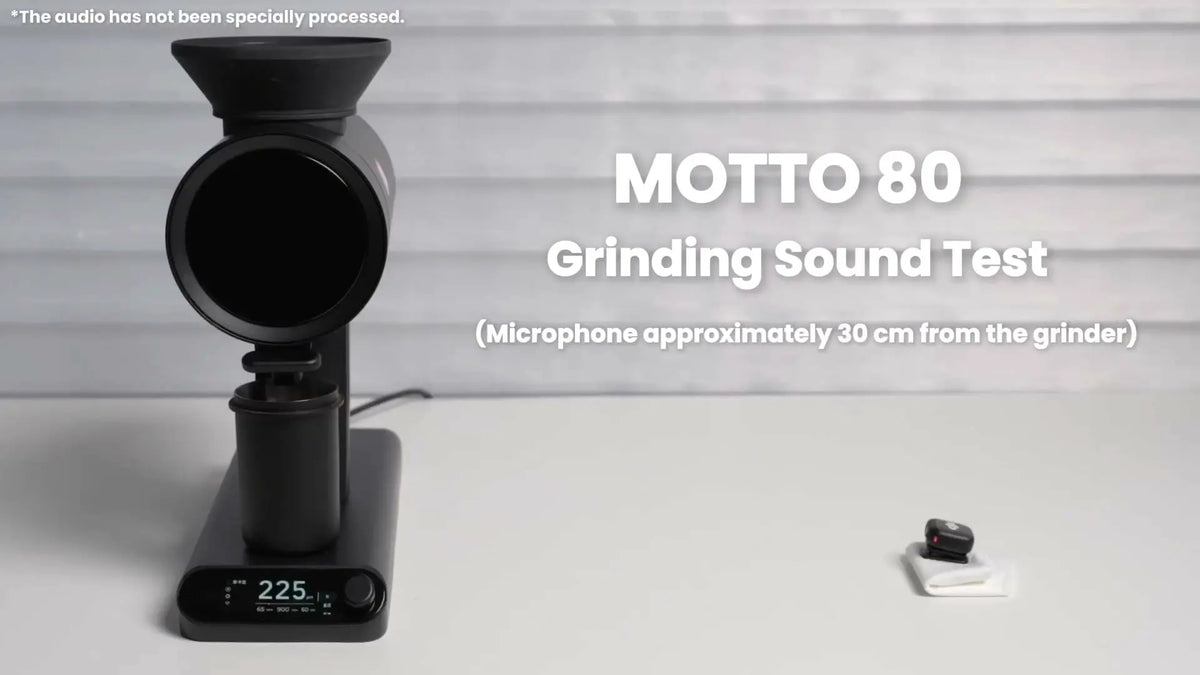
Some users have noticed a sharper sound when the Motto80 grinds at coarser filter settings. We recorded a three-part comparison to show when the sound appears and what changes when the bean feeder is removed.
In our current testing, the main factor is the relationship between bean feed rate and how quickly the burrs process the coffee. We find the sound acceptable in daily use, but we also understand why some users would prefer it to be smoother.
Watch the comparison
The video compares three setups at the same burr speed of 900 r/min. Each player below opens the relevant part of the comparison.
Fine espresso setting
Grind setting: 225 µm
Bean feeder: 65 rpm
Burr speed: 900 r/min
Video segment: 00:00 to 00:29
The sharper high-frequency component is less prominent at this setting. Lower-frequency grinding sound is easier to hear.
Coarse filter setting with the bean feeder fitted
Grind setting: 600 µm
Bean feeder: 65 rpm
Burr speed: 900 r/min
Video segment: 00:29 to 00:54
A slight higher-frequency sound becomes more noticeable at the coarse setting.
Coarse filter setting with the bean feeder removed
Grind setting: 600 µm
Bean feeder: removed
Burr speed: 900 r/min
Video segment: 00:54 to 01:05
The distinctive higher-frequency component is substantially reduced after the feeder is removed.
Watch the complete Motto80 grinding sound comparison on YouTube
We recorded the test with a Mic 2 positioned approximately 30 cm from the grinder. The audio was not specially processed. Microphone placement and playback equipment still affect what you hear, so the video is most useful as a comparison between the three setups rather than as an absolute loudness test.
Phone microphones can also make higher-frequency sounds seem sharper than they do in person. That is one reason we used a separate microphone for this recording.
Why the sound changes at filter settings
Grinding load depends on both sides of the process: how quickly beans enter the burrs and how quickly ground coffee leaves them.
At a coarse filter setting, particularly at a higher burr speed, the burrs can process coffee quickly. If the feeder supplies beans more slowly than the burrs can process them, the amount of coffee between the burrs changes as the grinder runs. Based on our testing, that changing load is the main source of the sharper sound.
Put simply, the burrs are sometimes processing beans faster than new beans arrive.
This does not, by itself, indicate insufficient motor torque or unstable burr speed. The burr speed remains the same in all three parts of the comparison. What changes in the final test is how the beans enter the burrs.
Slow feeding does not always mean quieter grinding. It changes the flow of beans into the grinding chamber, and the result depends on the feed rate, grind size, and burr speed together.
At the finer espresso setting in the video, grinding resistance and material flow are different. The sharper high-frequency component is less prominent. At the coarse filter setting with the feeder fitted, it becomes easier to hear. When the feeder is removed, that component is substantially reduced.
For a more detailed look at how feed rate, burr throughput, motor load, and RPM work together, read Once the Beans Reach the Burrs: How We Designed the BOOKOO Motto80 Drive System.
What the feeder comparison tells us
The third test helps separate the sound of the grinding system from the effect of the feeding arrangement. The grind setting stays at 600 µm and the burr speed stays at 900 r/min, but removing the feeder changes the sound noticeably.
That result is why we are focusing on the relationship between feed rate and burr processing capacity.
We have also redesigned the bean-feeder structure to reduce its no-load mechanical sound. The updated feeder will be provided free of charge to all pre-order customers and will be used on future production units.
The updated structure addresses sound from the feeder itself. The sharper sound heard while grinding at some coarse settings is a separate issue, and that is where feed rate becomes important.
What it sounds like in daily use
In our team's experience, the sharper sound is noticeable at some filter settings but remains acceptable for everyday use. A recording cannot fully reproduce what it sounds like beside the grinder, and sensitivity to higher-frequency sound varies from person to person.
For that reason, we suggest listening for the difference between the three setups instead of judging the grinder's absolute loudness from a single clip.
Finding the current sound acceptable does not mean we should ignore requests for a smoother sound. The comparison gives us a clearer idea of what to change and what to test next.
What we are evaluating next
For users who do not need slow feeding and would prefer a smoother grinding sound, we are evaluating a higher maximum bean feed rate at filter settings.
The aim is to bring the incoming bean flow closer to the burrs' processing capacity. This may reduce the sharper component heard in the current comparison. We still need to evaluate the change together with grinding performance before deciding how to implement it.
Motto80 is designed to let users adjust both burr speed and bean feed rate. We want that flexibility to remain useful without making the grinder less pleasant to listen to in everyday use.
Thank you to everyone who has shared feedback on the Motto80. It has helped us narrow down where the sound comes from and what we should test next.
Share:
An Update on Our European Pricing | Effective September 25, 2026